
General Assembly endorses New York Declaration on two-State solution between Israel and Palestine
The New York Declaration is the outcome of an international conference held in July at UN Headquarters, organized by France and Saudi Arabia, which resumes later this month. The General Assembly comprises all 193…

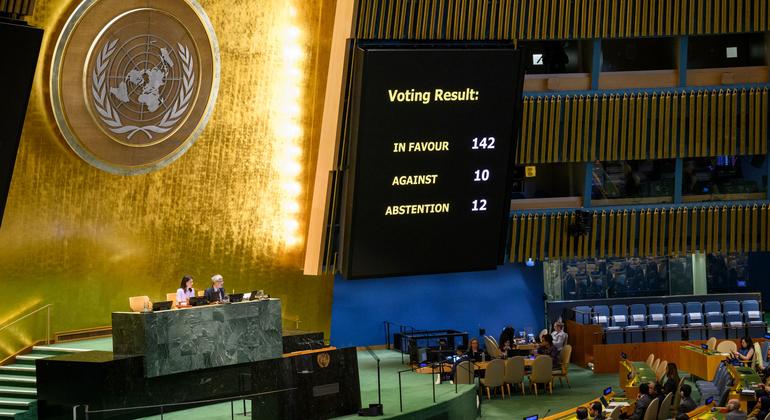
The New York Declaration is the outcome of an international conference held in July at UN Headquarters, organized by France and Saudi Arabia, which resumes later this month.
The General Assembly comprises all 193 UN Member States and 142 countries voted in favour of a resolution backing the document.
Israel voted against it, alongside nine other countries – Argentina, Hungary, Micronesia, Nauru, Palau, Papua New Guinea, Paraguay, Tonga and the United States – while 12 nations abstained.
‘Roadmap’ for the future
Prior to the vote, French Ambassador Jérôme Bonnafont recalled that the New York Declaration “lays out a single roadmap to deliver the two-State solution”.
This involves an immediate ceasefire in Gaza, release of all hostages held there, and the establishment of a Palestinian State that is both viable and sovereign.
The roadmap further calls for the disarmament of Hamas and its exclusion from governance in Gaza, normalization between Israel and the Arab countries, as well as collective security guarantees.
Speaking ahead of the vote, Israeli Ambassador Danny Danon said that “this one-sided Declaration will not be remembered as a step toward peace, only as another hollow gesture that weakens this Assembly’s credibility.”
He said that “Hamas is the biggest winner of any endorsement here today” and will declare it “the fruit of 7 October”.
The high-level international conference in July was held against the backdrop of the war in Gaza and deteriorating prospects for the two-State solution.
In remarks to the opening segment, UN Secretary-General António Guterres noted that “the central question for Middle East peace is implementation of the two-State solution, where two independent, sovereign, democratic States – Israel and Palestine – live side-by-side in peace and security.”
More from Geopolitics & Diplomacy Desk

Qatar’s 2030 Strategy Puts Productivity at Centre
Qatar’s next development phase is focused less on headline expansion and more on productivity, diversification and private-sector capability.
Oman Vision 2040 Seeks Quieter Path to Integration
Oman’s long-term reform agenda is drawing attention as a measured model of diversification, logistics and regional connectivity.

Synthetic drug market disrupted in Syria after regime change
Captagon, a highly addictive stimulant, has been circulating illegally from the Middle East to Africa and back with…