
Amid massive destruction of Gaza City, UN chief renews ceasefire call
“It is vital to reach immediately a ceasefire in Gaza,” the Secretary-General told reporters on the sidelines of the Ninth Tokyo International Conference on African Development (TICAD9), “and the unconditional release of all hostages and to…

“It is vital to reach immediately a ceasefire in Gaza,” the Secretary-General told reporters on the sidelines of the Ninth Tokyo International Conference on African Development (TICAD9), “and the unconditional release of all hostages and to avoid the massive death and destruction that a military operation against Gaza City would inevitably cause.”
Around one million people still live in the city – Gaza’s largest – in the north of the war-torn enclave. The Israeli army has reportedly described it as a stronghold of Hamas, the terror group whose deadly attacks in Israel and hostage-taking sparked the war on 7 October 2023.
The UN chief also condemned the Israeli Government’s decision to approve a long-shelved settlement expansion project in the occupied West Bank.
“The decision by the Israeli authorities to expand illegal settlement construction, which would divide the West Bank, must be reversed. All settlement construction is a violation of international law,” he insisted.
The settlement is believed to have permission for well over 3,000 houses, schools and a clinic, cutting off East Jerusalem from the occupied West Bank, which Israel captured during the 1967 Six-Day war after defeating Egypt, Jordan and Syria.
Urban destruction
Meanwhile in Gaza City, whole urban areas are being “totally destroyed”, the UN understands, with further destruction now underway in the south and southeast, as military manoeuvres continue.
Recent attacks have been particularly devastating in the Az Zaytoun neighbourhood of the city, the UN human rights office (OHCHR) reported on Wednesday.
Highlighting more than 50 attacks on residential buildings and entire blocks in Gaza City since 8 August, OHCHR warned that its “systematic destruction” had begun.
Acute malnutrition soaring
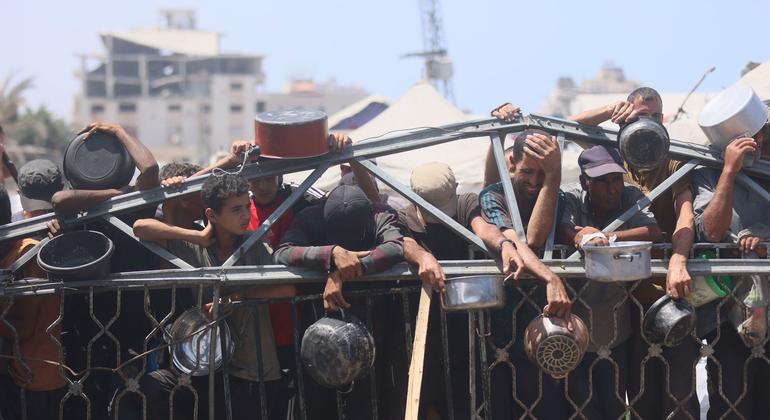
Meanwhile, UN aid teams highlighted the catastrophic impact of the accelerating Israeli military operation, with acute malnourishment soaring among children in Gaza City to 28.5 per cent, or more than one in four youngsters.
“Children continue to die from man-made starvation,” UNRWA said in a statement, noting that it has screened more than 95,000 children aged six months to five years for malnutrition across the Gaza Strip since March 2025, after the ceasefire collapsed.
While the ceasefire still held in early March and relief supplies were allowed into Gaza in far greater quantities than today, malnutrition rates were six times lower in Gaza City, at 4.5 per cent, according to the UN agency for Palestinians, UNRWA.
Across Gaza, acute malnutrition rose to nearly 16 per cent in mid-August, more than three times higher than the 5.2 per cent level recorded by the UN agency in March, it said.
Vital services in danger
Today, services provided by UNRWA in Gaza City are at “severe risk”, the agency warned, pointing to the tens of thousands of people who still live in its shelters and the “many more” who remain in surrounding areas.
There is particular concern for UNRWA’s Gaza Field Office compound – its largest logistics hub in northern Gaza – as the UN agency’s operations in the south have been “crippled” by displacement orders and bombardment.
As an indication of UNRWA’s key role in aid and relief provision across Gaza, it noted that last month alone, it provided more than 100,000 medical consultations and screened 3,500 children for malnutrition in Gaza City.
UNRWA also delivered drinking water to 220,000 people, domestic water to 250,000 and cleared hundreds of tons of waste.
Education and protection specialists from the UN agency reached thousands more in temporary learning spaces or by offering counselling, recreational activities and risk awareness training about the dangers of lethal unexploded weapons.
“While our colleagues, like the rest of the UN, are determined to stay and deliver, all of these services are now at risk as the military operations intensify,” UNRWA said.
More from Geopolitics & Diplomacy Desk

Qatar’s 2030 Strategy Puts Productivity at Centre
Qatar’s next development phase is focused less on headline expansion and more on productivity, diversification and private-sector capability.

Oman Vision 2040 Seeks Quieter Path to Integration
Oman’s long-term reform agenda is drawing attention as a measured model of diversification, logistics and regional connectivity.

Synthetic drug market disrupted in Syria after regime change
Captagon, a highly addictive stimulant, has been circulating illegally from the Middle East to Africa and back with…