
Yemen calls for ‘firm international action’ to counter global threat posed by Houthis
Since 2014, Yemen has been engulfed in conflict between the internationally recognised government and Houthi militants (formally known as the Ansar Allah movement). A fragile truce brokered in 2022 has helped reduce the fighting…

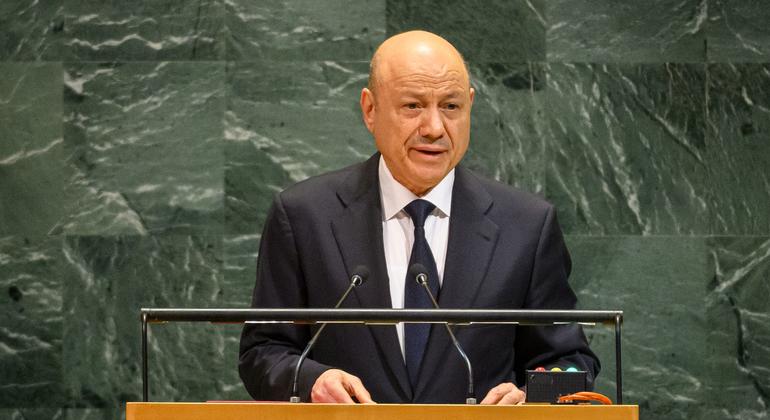
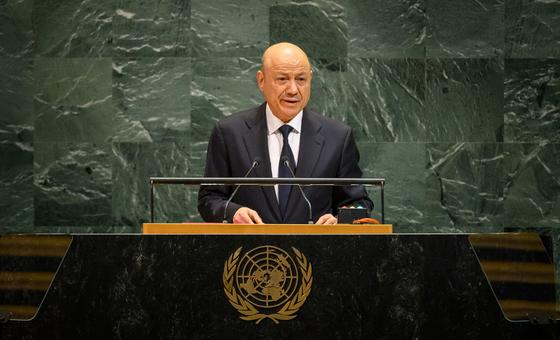
Since 2014, Yemen has been engulfed in conflict between the internationally recognised government and Houthi militants (formally known as the Ansar Allah movement). A fragile truce brokered in 2022 has helped reduce the fighting but violations are ongoing.
Millions have been displaced across the country – already one of the poorest in the Middle East – while public services and infrastructure have collapsed.
Humanitarian workers have also been targeted by the Houthis – who control large swathes of the country including the capital – with dozens of UN staff detained by the group and agency offices raided.
“The Houthi militias are no longer a rebel group in a remote area,” President Al-Alimi told the General Assembly’s annual debate.
International terror group
“Rather, they are [an] international terrorist organization armed to the teeth with an advanced Iranian arsenal, including ballistic missiles and drones, booby-trapped boats and sea mines, and missiles and other qualitative weapons that are internationally banned.”
Mr. Al-Alimi – who heads Yemen’s Presidential Leadership Council – said that after more than a decade of war, Yemenis are living through “one of the greatest humanitarian crises” while also facing “security threats that transcend our borders and spread to the region and the entire world.”
He accused the Houthis of using “hunger as a weapon, religion as a tool and maritime passages as a means of blackmail,” warning that the Red Sea and international shipping lanes risk becoming permanent prey to terrorism.
He dismissed years of international containment efforts as ineffective.
“The policy of conflict management by offering more incentives has only brought more disaster and destruction,” he said.
He said the UN has been “unable to protect its own staff, who were kidnaped in Sanaa, unable to protect the oil installations and the commercial ships.”
Call for effective action
The Yemeni leader called for an “effective international coalition to restore security, stability and a coalition that would rebuild the institutions of the State and would liberate the country from the clutches of the militias and all forms of terrorist groups.”
Yemen’s crisis is a test of international credibility, he stressed.
“What we ask from you are not new statements, but international action – firm international action – to support the legitimate government as a trusted partner on the ground.”
He reaffirmed Yemen’s support for the Palestinian cause, welcomed growing international recognition of a Palestinian State, and expressed gratitude to Saudi Arabia and the United Arab Emirates for their sustained support for his country.
“Yemen and Gaza…are the moral testing ground of this [United Nations]. They are the place where we can definitely confirm that the might of right is still able to confront the right of might.”
More from Geopolitics & Diplomacy Desk
Qatar’s 2030 Strategy Puts Productivity at Centre
Qatar’s next development phase is focused less on headline expansion and more on productivity, diversification and private-sector capability.
Oman Vision 2040 Seeks Quieter Path to Integration
Oman’s long-term reform agenda is drawing attention as a measured model of diversification, logistics and regional connectivity.

Synthetic drug market disrupted in Syria after regime change
Captagon, a highly addictive stimulant, has been circulating illegally from the Middle East to Africa and back with…